
Stability Testing Considerations for Sleep Gummies, Powders and Capsules
Stability planning connects formula, process, packaging, storage conditions and shelf-life support. Gummies, powders and capsules fail in different ways, so the protocol and acceptance criteria should be designed around the actual product rather than copied from a generic template.
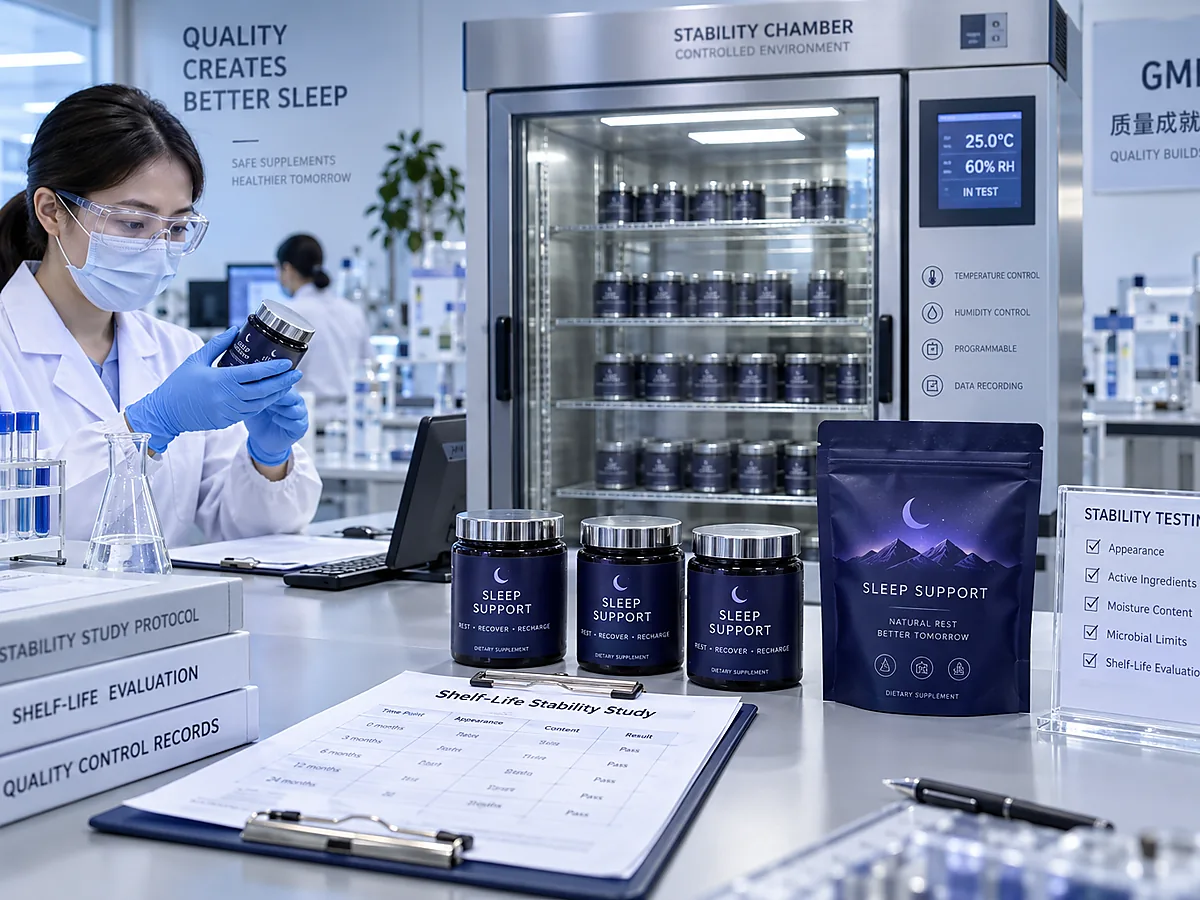
A successful initial sample does not establish shelf life. Define the commercial formula and package, identify physical, sensory and analytical risks, agree on storage conditions and time points, and document how results will support the labeled product.
Direct Answer for Buyers
A successful initial sample does not establish shelf life. Define the commercial formula and package, identify physical, sensory and analytical risks, agree on storage conditions and time points, and document how results will support the labeled product.
Stability begins during formulation
Shelf-life questions cannot be solved after the product is finished if the formula and package were never designed for protection. Ingredient sensitivity, moisture behavior, physical structure, flavor and container barrier should be considered during feasibility and sampling.
A change to raw material, process, flavor or package can affect the stability basis. Version control is therefore essential: the tested sample must represent the commercial product closely enough for the intended conclusion.
Define product-specific failure modes
Gummies may change in texture, surface, color, flavor or moisture. Powders may clump, discolor, lose flow or change dispersion and aroma. Capsules may show shell changes, odor, appearance or blend-related issues. Analytical attributes depend on the selected ingredients and market requirements.
The protocol should identify what will be observed or tested and the acceptance basis. Testing unrelated attributes while ignoring the likely physical failure mode produces a weak shelf-life argument.
Use the commercial packaging system
Barrier, headspace, closure, desiccant where applicable and unit-dose seals influence product behavior. Samples stored in laboratory containers do not fully represent a commercial bottle, pouch or stick. Packaging should be finalized or clearly identified before the main stability program begins.
Secondary cartons may protect from light or physical damage but do not automatically replace the primary package barrier. The role of each component should be understood.
Choose conditions and time points deliberately
Study design depends on target market, product, intended shelf life and the purpose of the data. Real-time and accelerated conditions answer different questions and accelerated results are not a universal substitute for real-time evidence.
The project team should agree on conditions, time points, sample quantity, test panel and decision rules before starting. Unplanned testing can leave missing samples or inconsistent methods.
Connect sensory and analytical review
A product can remain analytically within an agreed range yet become unacceptable in taste, texture or appearance. Conversely, an attractive sample does not prove active content. Stability review should include the relevant combination of physical, sensory, microbiological and analytical criteria for the product.
Methods, laboratories and acceptance criteria should be appropriate to the agreed specification and destination responsibilities. No generic website statement can replace the project protocol.
Manage conclusions and changes
Results should identify the exact formula, batch and packaging tested. If a significant change is introduced, the team should assess whether existing evidence still applies. Shelf-life wording must remain consistent with the available support and market review.
MITEYO Sleep can coordinate project-specific stability planning where agreed. Scope, cost, timing and responsibility are confirmed after the formula, packaging and market are defined.
Buyer Decision Matrix
| Format | Common physical questions | Packaging connection |
|---|---|---|
| Gummies | Texture, stickiness, hardening, color and flavor | Moisture barrier, closure and headspace |
| Powders | Clumping, flow, color, aroma and dispersion | Film or container barrier and closure |
| Capsules | Shell condition, appearance, odor and moisture | Bottle barrier, closure and internal protection |
| Oral films | Flexibility, handling, dissolution and tackiness | Individual pouch seal and humidity barrier |
Procurement and Development Checklist
- Freeze the formula and material specifications.
- Identify likely failure modes.
- Use the intended commercial package.
- Agree conditions, time points and sample quantity.
- Define physical, sensory and analytical criteria.
- Record batch and package identity.
- Assess the effect of every later change.
Related Buyer Guides and Capabilities
Frequently Asked Questions
Does an accelerated study prove the full shelf life?
Accelerated and real-time studies have different roles. The conclusion should follow the agreed protocol, product evidence and applicable market expectations.
Can a sample in a laboratory jar represent the final bottle?
Not completely. Packaging components and barrier performance affect product behavior, so commercial packaging should be incorporated into the relevant study.
What happens if the flavor changes after testing starts?
The team should assess whether the change affects the stability basis and whether additional work is needed.
Is stability testing identical for every sleep supplement?
No. The formula, dosage form, packaging, intended shelf life and target market determine the appropriate plan.
Start Your Sleep Supplement Project
Tell us your target market, formula direction, dosage form, packaging and estimated order quantity.