
Oral Sleep Strip Formulation Feasibility: Active Load, Dissolution and Pouch Protection
Oral sleep strips suit portable, low-load and compatible active systems. Film size, thickness, polymer structure, ingredient distribution, taste, mouthfeel, dissolution and individual moisture-barrier packaging must be reviewed together.
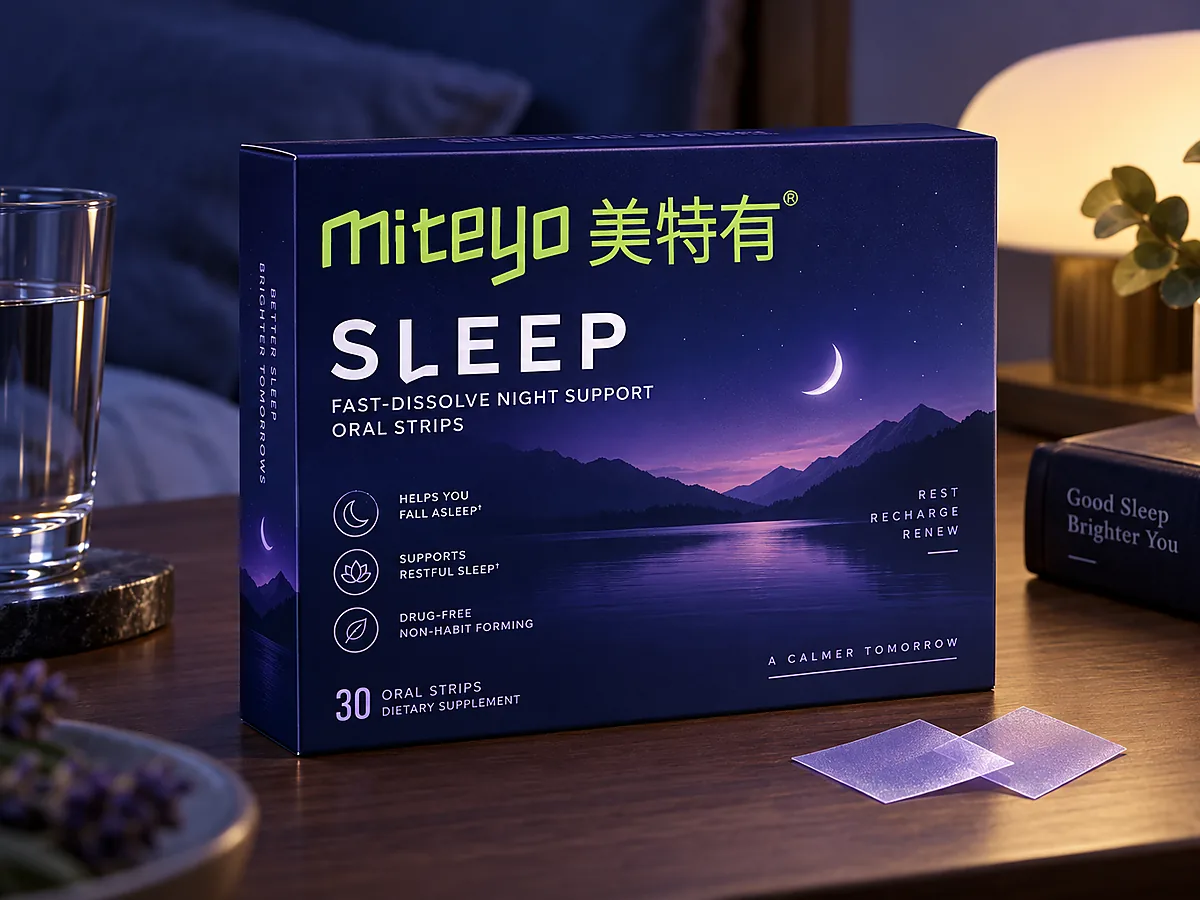
A capsule or gummy formula cannot be copied directly into an oral film. Start with a prioritized low-load active system, then validate film integrity, uniformity, sensory performance, dissolution and sealed-pouch protection.
Direct Answer for Buyers
A capsule or gummy formula cannot be copied directly into an oral film. Start with a prioritized low-load active system, then validate film integrity, uniformity, sensory performance, dissolution and sealed-pouch protection.
Recognize the format’s load constraint
An oral film must remain thin, flexible, handleable and acceptable in the mouth. Large mineral or amino-acid loads can overwhelm the film matrix or require an impractical size. The product brief should therefore prioritize essential actives and avoid copying a high-mass capsule or powder formula.
Feasibility depends on actual material form and properties, not ingredient name alone. Potency, particle size, solubility, taste and interaction with the film system all matter.
Design the film as a matrix
Film-forming polymers, plasticizers, flavors, sweeteners and other functional components create the structure that carries the active system. Changing the active load can alter thickness, strength, flexibility or drying behavior. The formula is a matrix, not active powder placed on a sheet.
The approved specification should identify dimensions, appearance, handling and relevant performance expectations in addition to ingredient composition.
Control distribution and serving basis
Low-dose ingredients require controlled mixing and distribution across the film. The cutting pattern and unit dimensions connect the bulk film to the declared serving. Manufacturing and verification plans should be specific to the formula and intended market.
A general factory capability statement does not prove that every proposed active combination will meet unit expectations. Project-specific development and batch documentation are needed.
Balance taste, mouthfeel and dissolution
The consumer experiences the film directly. Bitterness, herbal notes, residue, tackiness and aftertaste can affect acceptance even when the strip dissolves. Flavor and sweetener selection must work within the small format without weakening the film.
Dissolution should be evaluated under an agreed method. A faster result is not automatically better if handling or mouthfeel deteriorates. The target experience should be defined and compared across coded prototypes.
Protect every strip from moisture
Oral films are sensitive to humidity and handling. Individual barrier pouches commonly form part of the product system, but the exact material, seal and dimensions require review. Secondary cartons or dispensers should protect the pouches and communicate count and use.
A film approved outside its commercial pouch still needs packaging confirmation. Seal integrity and storage behavior belong to the development and verification plan.
Use a controlled approval path
Approve ingredient priorities, film feasibility, coded sample, unit dimensions, sensory reference, dissolution basis, pouch and secondary packaging before commercial production. Artwork should use confirmed strip and pack information.
Exact capacity, MOQ, lead time and market suitability are not universal. They depend on formula, film, packaging, testing and destination-market review.
Buyer Decision Matrix
| Feasibility area | Buyer question | Required output |
|---|---|---|
| Active load | Can essential materials fit a practical film? | Prioritized formula direction |
| Film structure | Does the matrix remain flexible and handleable? | Physical sample and specification |
| Uniformity | How is the serving distributed and cut? | Project-specific process and test basis |
| Sensory / dissolution | Is the mouth experience acceptable? | Coded approved prototype |
| Packaging | What protects each film from humidity? | Approved pouch and secondary pack |
Procurement and Development Checklist
- Prioritize low-load essential actives.
- Provide material specifications.
- Define strip dimensions as a target, not an assumption.
- Evaluate handling, taste, residue and aftertaste.
- Agree on dissolution method.
- Confirm individual pouch barrier and seal.
- Link cutting, serving and artwork information.
Related Buyer Guides and Capabilities
Frequently Asked Questions
Can an oral strip carry magnesium at the same serving as a powder?
A high material load may be impractical in a thin film. The actual material and serving need feasibility review, and another format may be more suitable.
Why are individual pouches used?
They can help protect films from humidity and handling, but the exact material and seal must be selected for the product.
Does fast dissolution prove product quality?
No single performance attribute proves the whole product. Film integrity, unit consistency, sensory experience, packaging and documentation also matter.
Can strip size be fixed before formulation?
It can be a design target, but final dimensions depend on active load, film structure and manufacturing feasibility.
Start Your Sleep Supplement Project
Tell us your target market, formula direction, dosage form, packaging and estimated order quantity.